
2026/8/24
In the first half of 2026, global economic growth generally slowed amid the dual impacts of geopolitical conflicts and the energy crisis, while inflationary pressures intensified in many countries. China’s domestic economy withstood external pressures and maintained a generally stable trajectory, with continued progress toward innovation-driven and higher-quality development, demonstrating strong resilience and vitality.
Against this backdrop, China’s technical textiles industry maintained a generally stable and improving performance. Growth in industrial added value rebounded markedly compared with the second half of 2025, while production and exports achieved medium-to-high growth. However, the industry’s overall profitability remained under pressure.
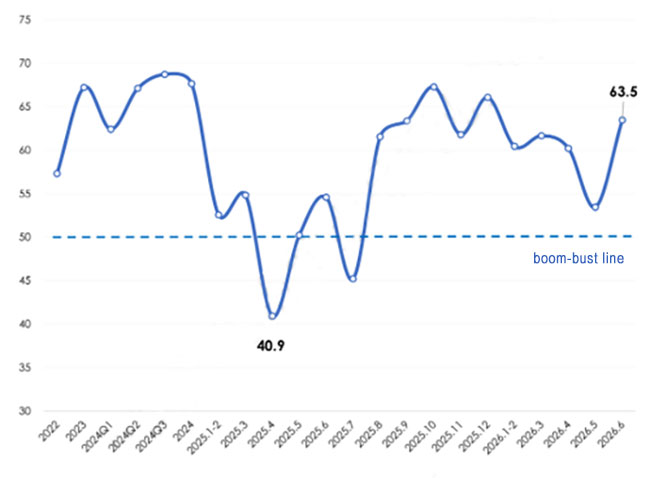
According to a survey conducted by the China Nonwovens and Industrial Textiles Association (CNITA), the industry prosperity index stood at 63.5 in the first half of 2026 (Figure 1), remaining in expansion territory. The index improved from the first quarter but edged down slightly from the end of 2025. Entrepreneurs’ perceptions of business conditions were better than in the same period of 2025.
Figure 1: Prosperity Index of China’s Technical Textiles Industry
Source: China Nonwovens and Industrial Textiles Association
I. Market Demand and Production
In the first half of 2026, both domestic and overseas demand for China’s technical textiles industry improved.
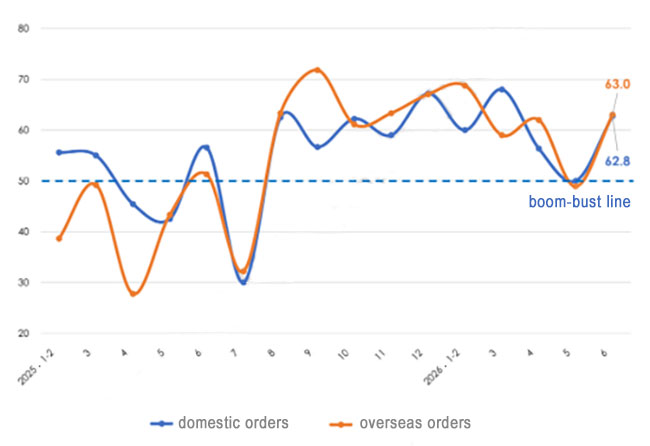
According to a survey of key member enterprises, the domestic and overseas order indices reached 62.8 and 63.0, respectively (Figure 2), from January to June, up 6.2 points and 11.8 points from the same period in 2025. However, order conditions varied significantly by enterprise size. Large enterprises generally had sufficient and stable order backlogs, supporting continuous production over a relatively long period. The proportion of medium-sized enterprises obtaining stable orders fell by around 20% compared with 2025. Small and micro enterprises had relatively weak order reserves, with half reporting that their current orders could sustain operations for no more than one month. Meanwhile, cyclical fluctuations in procurement in certain application markets also affected industry demand to some extent.
Figure 2: Domestic and Overseas Market Demand for China’s Technical Textiles Industry from 2025 to June 2026
Source: China Nonwovens and Industrial Textiles Association
Production maintained relatively rapid growth in the first half of 2026, with the monthly production index remaining in expansion territory. According to the association’s survey, the capacity utilization rate of sample enterprises reached 79.4% from January to June, up 3.2 percentage points year-on-year. Around 20% of enterprises surveyed reported capacity utilization rates above 90%.
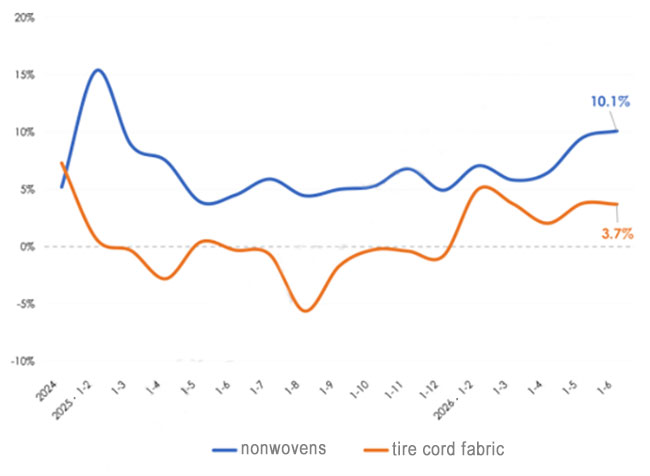
According to the National Bureau of Statistics, output of nonwovens by enterprises above designated size increased by 10.1% year-on-year from January to June, of which exports reached 938,000 tons, up 14.8%. Output of tire cord fabric increased by 3.7% year-on-year (Figure 3).
Figure 3: Y-o-Y Growth Rates of Nonwovens and Tire Cord Fabric Output of Enterprises Above Designated Size from 2024 to June 2026
Source: National Bureau of Statistics; China Nonwovens and Industrial Textiles Association
II. Economic Performance
In the first half of 2026, China’s technical textiles industry demonstrated strong resilience, although profitability remained under considerable pressure.
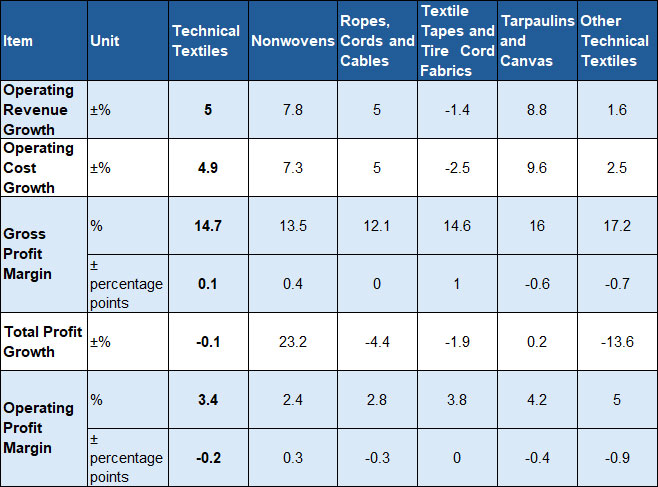
According to the National Bureau of Statistics, operating revenue of enterprises above designated size in the technical textiles industry increased by 5% year-on-year from January to June, while total profits edged down by 0.1%. The industry’s gross profit margin stood at 14.7%, up 0.1 percentage point, while the operating profit margin was 3.4%, down 0.2 percentage point (Table 1).
Since 2025, the industry’s gross profit margin has remained relatively stable and even increased slightly, indicating generally stable fundamentals in terms of supply-demand conditions and competitive intensity. However, profit growth has consistently lagged and remained in negative territory for an extended period, as rapidly rising expenses and operating losses have eroded profits.
Loss-making conditions continued to improve. The proportion of loss-making enterprises above designated size fell to 23.6%, narrowing by 3 percentage points from the first half of 2025. Losses incurred by loss-making enterprises declined by 7%.
Table 1: Major Economic Indicators of China’s Technical Textiles Industry from January to June 2026 (Enterprises Above Designated Size)
Source: National Bureau of Statistics; China Nonwovens and Industrial Textiles Association
Overall, finished product prices remained a major factor affecting industry profits. Significant fluctuations in raw material markets during the first half of the year also added to profitability pressures.
III. International Trade
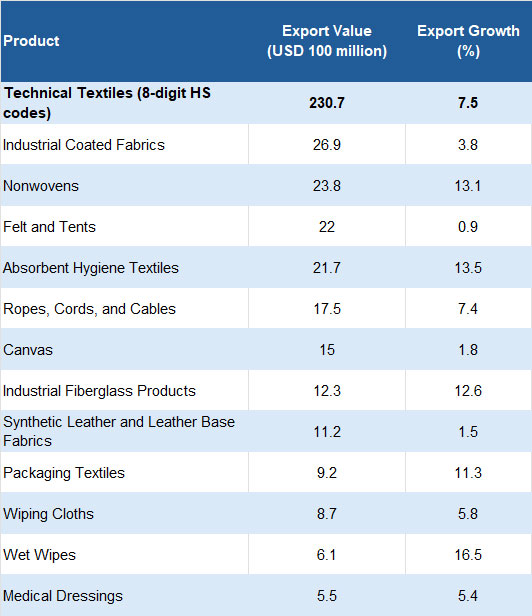
In the first half of 2026, China’s technical textiles industry showed strong resilience and vitality in international trade, with both imports and exports recording growth and the international competitiveness of key products further strengthening. According to China Customs data, exports of China’s technical textiles industry, based on 8-digit HS codes, totaled US$23.07 billion from January to June, up 7.5% year-on-year. Imports reached US$2.81 billion, up 5.2%.
By product category, coated industrial fabrics remained the largest export item, with export value reaching US$2.69 billion, up 3.8% year-on-year. Among other key products, exports of ropes, cords and cables, canvas, industrial glass fiber products, leather base fabrics, and packaging textiles all recorded varying degrees of growth (Table 2). From the perspective of export prices, unit prices for most products continued to decline, except for a small number of high-end technical textile products.
Table 2: Exports of China’s Technical Textiles Industry and Major Products from January to June 2026
Source: China Customs; China Nonwovens and Industrial Textiles Association
The United States, Vietnam, Japan, South Korea, and Russia were the major export markets for China’s technical textiles, together accounting for around one-third of total exports. The United States remained the largest single export market. In the first half of 2026, amid an easing in China-US relations, China exported US$2.72 billion worth of technical textiles to the United States, up 5.2% year-on-year. Exports to major markets including Vietnam, South Korea, and Russia strengthened, all achieving double-digit growth. Exports of technical textiles to countries participating in the Belt and Road Initiative reached US$13.98 billion, up 8% year-on-year and accounting for around 60% of the industry’s total exports.
IV. Full-Year Outlook
2026 marks the first year of China’s 15th Five-Year Plan period. A series of national special plans have created broad opportunities for technological innovation and market application in the technical textiles industry, while the long-term fundamentals of the domestic demand market remain sound.
At present, the overall domestic and international market landscape for the technical textiles industry remains broadly stable. However, fluctuations in certain application sectors may have an impact on the industry. For example, declines in China’s automobile production and sales could significantly affect demand, production, profitability, and payment collection across the automotive textiles supply chain.
From a longer-term perspective, the pressure of rising raw material prices is expected to gradually passed downstream, reducing its negative impact on the industry over time. At the same time, higher raw material prices may also push up revenue growth to some extent.
For enterprises, strengthening product innovation, optimizing sales channels, upgrading brands through technological innovation, and leveraging economies of scale will remain key pathways to building core competitive advantages. However, as product iteration cycles shorten, the period during which firms can benefit from technological innovation is also narrowing. In addition, excessive and homogeneous competition in some segments will remain a major constraint on the industry’s high-quality development.
Looking ahead to the second half of 2026, demand for major technical textile products in both domestic and overseas application markets is expected to remain stable. Production, sales, and exports are likely to maintain relatively rapid growth, while industry profitability is expected to improve further.
Source: CHINA TEXTILE LEADER Express


Authority in Charge: China National Textile and Apparel Council (CNTAC)
Sponsor: China Textile Information Center (CTIC)
ISSN 1003-3025 CN11-1714/TS

© 2026 China Textile Leader, all rights reserved.
Powered by SeekRay