
2026/3/20
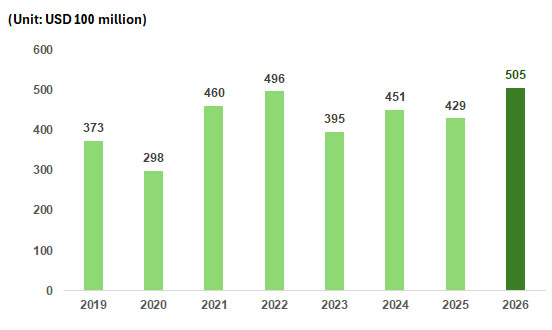
According to the General Administration of Customs, in the first two months of this year, the cumulative export value of textiles and apparel nationwide reached US$50.5 billion (see figure 1), up 17.6% year-on-year, marking a rebound of 22.1 percentage points compared to the growth rate of the same period last year. Specifically, textile exports amounted to US$25.57 billion, up by 20.5% year-on-year, continuing the strong growth trend seen since last year; apparel exports totaled US$24.87 billion, up 14.8% year-on-year, with the growth rate expanding rapidly.
Figure 1: Cumulative Export Value of China’s Textiles and Apparel for the First Two Months (2019–2026)
In CNY-denominated terms, from January to February, China’s textiles and apparel exports reached 355.04 billion yuan, seeing a year-on-year increase of 13.2%. Of this, textile exports were 180.01 billion yuan, up 18% year-on-year, while apparel exports were 175.03 billion yuan, up 12.4% year-on-year.
Compared with historical data for the same period, China’s textile and apparel exports in the first two months of this year have been generally positive. Despite the Spring Festival holiday occurring later in February, the cumulative export value of US$50.5 billion remains historically high. This performance is mainly attributed to a combination of factors, including rising prices of textile raw materials, a window of opportunity created by adjustments in U.S. tariff policies, active expansion into emerging markets by enterprises, and a relatively low base in the same period last year.
It is worth noting that data from January to February each year is significantly influenced by seasonal and holiday factors. Therefore, the future export trend still needs to be dynamically evaluated in conjunction with the overall performance of the first quarter and changes in the external environment. Looking ahead, the escalation of tensions in the Middle East is impacting global energy and trade chains; surging international oil prices are driving up upstream raw material costs such as chemical fibers and dyes; and risks associated with navigation through the Strait of Hormuz are leading to soaring sea freight rates and increased risks of shipping delays. Geopolitical conflicts and trade protectionism will continue to be the biggest variables affecting China’s textile industry.
Facing a complex and volatile international environment, China’s foreign trade enterprises in the textile sector need to strengthen risk hedging, continuously diversify markets, accelerate technological innovation and structural optimization, and promote the industry’s ascent from stabilizing the basic foreign trade framework to the high end of the global value chain.
Source: CHINA TEXTILE LEADER Express


Authority in Charge: China National Textile and Apparel Council (CNTAC)
Sponsor: China Textile Information Center (CTIC)
ISSN 1003-3025 CN11-1714/TS

© 2026 China Textile Leader, all rights reserved.
Powered by SeekRay